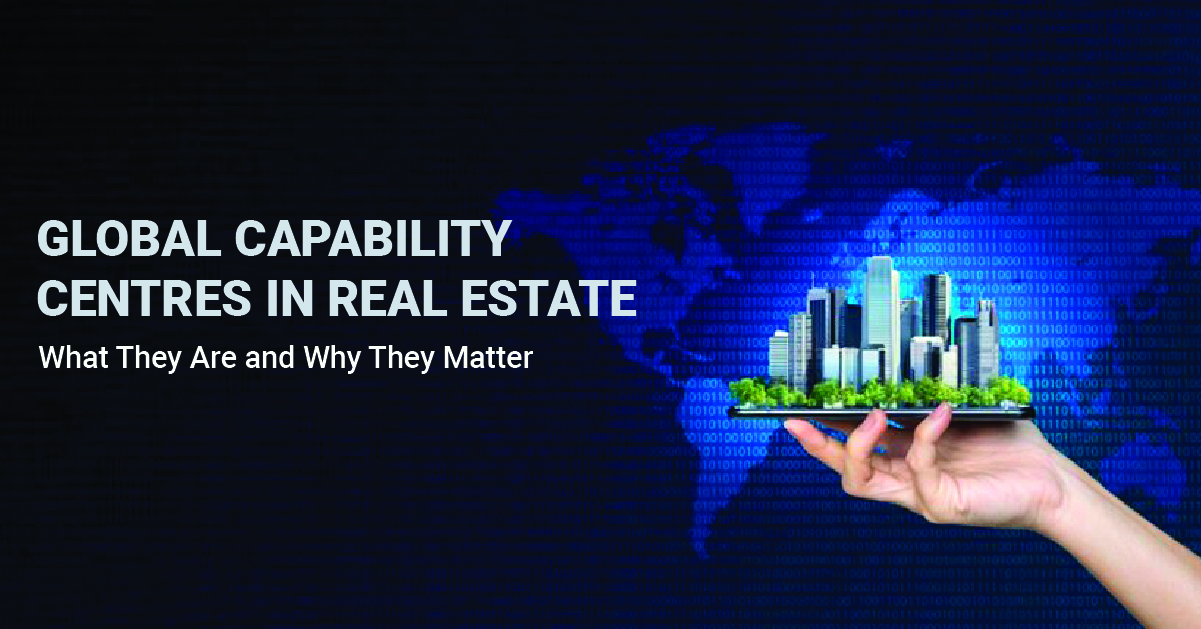
The corporate property sector is experiencing a fundamental transformation. Driven by rapid digital transformation, artificial intelligence, and strategic restructuring, multinational corporations (MNCs) are shifting away from third-party outsourcing models. Instead, major global enterprises are establishing their own fully owned hubs to manage high-value functions such as software engineering, data analytics, intellectual property, and research and development.
These strategic facilities are known as Global Capability Centres (GCCs) or Global In-house Centres (GICs). As international corporations scale these operations, GCCs have emerged as a primary engine of commercial property leasing, institutional investment, and broader urban real estate development.
Table of Contents
- Defining the Global Capability Centre
- The Intersection of GCCs and Real Estate
- Market Drivers Behind Investment Expansion
- How GCCs Shape Modern Workspace Infrastructure
- The Residential and Urban Development Ripple Effect
- The Long-term Strategic Outlook
Defining the Global Capability Centre
To understand this major economic movement, it helps to start by addressing the foundational question: what is a GCC?
A Global Capability Centre is an offshore operational unit set up directly by a parent organisation to handle core business operations internally. Historically, these hubs served as basic back-office units focused on low-cost administrative tasks. Today, modern capability centres are multi-functional strategic powerhouses that house data scientists, cybersecurity teams, innovation incubators, and senior executive leadership.
When evaluating a GCC from an operational standpoint, direct ownership is the defining feature. Unlike third-party IT contractors, a GCC is an integral extension of the parent company, operating under the same corporate culture, security protocols, and long-term strategic vision.
The Intersection of GCCs and Real Estate
In property terms, what is GCC in real estate refers to the dedicated demand from global firms for high-spec, tech-enabled, and sustainably built office buildings. GCC occupiers do not simply lease standard office space; they require customised, institutional-grade workspaces tailored to modern, hybrid work models.
These specialised property requirements include:
- High-Density Infrastructure: Dedicated floor plates equipped with secure server infrastructure, redundant power backups, and high-throughput data connections.
- Agile Collaborative Spaces: Modern office layouts featuring open project pods, innovation labs, and flexible zones designed to foster cross-functional teamwork.
- Employee Amenities: On-site dining, wellness areas, and recreational facilities built to attract and retain specialised technical talent.
- ESG and Green Certifications: Buildings holding recognised environmental certifications, directly helping global occupiers meet corporate net-zero commitments.
This focus on workspace specifications has set a high standard for Grade A commercial developments in receiving property markets.
Market Drivers Behind Investment Expansion
India’s real estate sector is expected to reach a market size of ₹83 lakh crore (US$ 1 trillion) by 2030, up from ₹16.6 lakh crore (US$ 200 billion) in 2021, supported by strong economic growth, digitalisation, and pro-business policy reforms. Within this ecosystem, commercial space has become a major destination for institutional funding.
The rapid rise of GCC investments in India highlights how global corporations view the market’s deep engineering talent pool, stable operating environment, and cost-effective commercial footprint. India currently hosts over 1,700 GCCs operating across sectors like banking, financial services, healthcare, life sciences, and consulting. With the market size projected to reach ₹8.3 lakh crore (USD 100 billion) by 2030 and employ over 2.5 million people, GCC investments in India have prompted top commercial developers to build large-scale enterprise campuses.
To establish these hubs, MNCs utilise varied real estate acquisition models, ranging from long-term leases and direct property ownership to innovative turnkey models like GCC-as-a-Service (GAAS) and government land allotments within Special Economic Zones (SEZs) or Integrated Township Projects (ITPs).
How GCCs Shape Modern Workspace Infrastructure
The proliferation of global capability centres in India has turned primary metropolitan areas into major regional innovation hubs. Major commercial centres account for the vast majority of enterprise office leases across the country:
- Bangalore: Karnataka hosts over 500 GCCs, with plans to add 500 more by 2029.
- Delhi-NCR: Gurugram and Noida collectively host over 450 GCCs, supported by business-friendly policy initiatives such as ‘Invest UP’.
- Mumbai: The nation’s financial capital hosts over 350 GCCs across major commercial nodes.
- Hyderabad: Supported by dedicated infrastructure like HITEC City, Hyderabad hosts more than 200 GCCs.
The continued expansion of global capability centres in India has influenced real estate trends across three main areas:
- Shift to Institutional Grade Assets: Enterprise tenants prioritise eco-friendly, professionally managed buildings that provide long-term operational stability.
- Expansion to Emerging Business Hubs: While primary business capitals host the highest concentration of facilities, enterprises are increasingly establishing units in secondary hubs to tap into fresh talent pools.
- Focus on Regulatory Compliance: Establishing these hubs requires navigating state-specific stamp duty norms, registration under the Registration Act of 1908, and state-level IT and GCC policy incentives.
The Residential and Urban Development Ripple Effect
The influence of Global Capability Centres extends far beyond commercial office towers; it directly transforms surrounding residential housing markets and urban infrastructure. When an MNC establishes a facility, it creates thousands of direct, high-skilled technical positions along with indirect service roles.
This growth brings well-paid professionals into surrounding suburban corridors, creating strong demand for quality residential properties near commercial hubs and transit networks. For instance, tech and finance professionals relocating close to major corporate hubs actively seek well-connected housing, boosting interest in flats for sale in Chennai and similar high-growth residential corridors.
This connection establishes a positive urban development loop:
- Modern commercial parks attract global corporate occupiers.
- Enterprise occupiers bring in high-earning, skilled professionals.
- Growing employment drives demand for local housing, retail spaces, and civic infrastructure upgrades.
The Long-term Strategic Outlook
Global Capability Centres are no longer temporary back-office tests; they are central pillars of global enterprise strategy. For commercial property developers, institutional investors, and urban planners, meeting the needs of these occupiers sets the benchmark for modern real estate development.
As multinational enterprises continue to prioritise digital innovation, operational resilience, and talent acquisition, capability hubs will remain a primary force driving real estate growth for years to come.