Choosing a home often starts with understanding what the available configurations actually mean. A property’s layout can influence how comfortably the space works for everyday routines, how much privacy it provides, and how well it suits the people living there.
The terms RK and BHK appear frequently across property listings, yet the distinction between them can shape the way a home is used and experienced. Understanding these configurations can make property searches more focused and help buyers assess options based on their practical requirements. Let’s explore the key features that can help you make a more informed choice.
Table of Contents
- RK vs BHK: Understanding the Key Differences
- How Do RK and BHK Layouts Work?
- How to Decide Between RK and BHK?
- Making the Right Choice for Your Home
- FAQs
RK vs BHK: Understanding the Key Differences
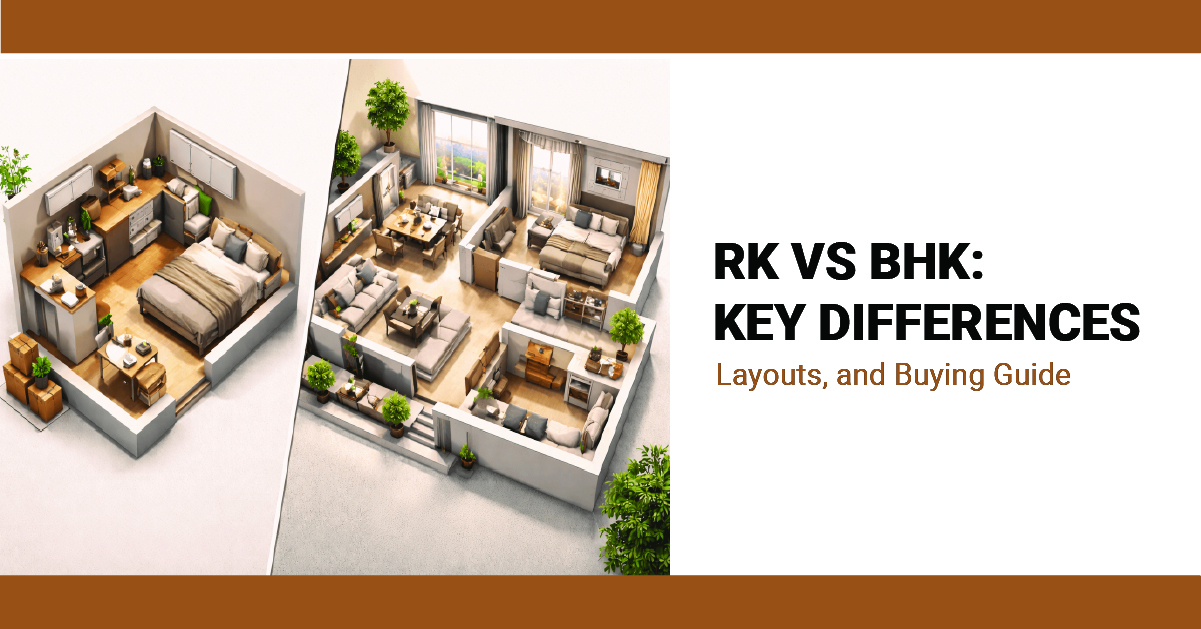
The difference between RK and BHK is largely based on the way each layout uses residential space. An RK brings living and sleeping functions together in one room with a kitchen, whereas a BHK separates these functions into a bedroom, hall, and kitchen.
| Feature | RK | BHK |
| Full form | Room-kitchen | Bedroom-hall-kitchen |
| Living arrangement | One main room serves multiple purposes | Separate bedroom and living area |
| Privacy | Limited due to shared space | Greater privacy with separate rooms |
| Space | Compact and space-efficient | More spacious and defined |
| Furniture options | Fewer arrangement possibilities | Greater flexibility for furniture |
| Kitchen | Separate kitchen or integrated into the main space | Separate kitchen |
| Maintenance | Generally easier to maintain | Requires more upkeep due to additional space |
| Typical suitability | Students, bachelors, and individuals | Families, couples, and shared households |
| Cost considerations | Generally more affordable | Usually involves higher purchase or rental costs |
| Long-term flexibility | Better suited to compact living | More adaptable to changing household needs |
How Do RK and BHK Layouts Work?
The layout determines how different parts of a home connect and how efficiently residents can use the available space. An RK typically brings several functions into one primary room, making it suitable for compact living. Furniture placement, storage, and organisation therefore play an important role.
A BHK separates the bedroom from the hall and kitchen, creating distinct areas for sleeping, relaxing, entertaining, and other daily activities. This separation can provide greater privacy and flexibility, particularly for households with multiple occupants.
Understanding how an RK differs from a BHK at the layout level can help buyers visualise how each configuration may fit their routines. Looking beyond the number of rooms and considering movement, furniture placement, storage, and privacy can make the comparison more practical.
How to Decide Between RK and BHK?
Your household size, lifestyle, and future plans can all influence whether an RK or BHK is the more suitable home for you.
- Consider Your Budget
Budget is one of the first factors to assess when selecting a home configuration. RK units generally require a smaller financial commitment because they offer a compact living arrangement with less space to purchase, furnish, and maintain.A BHK can involve higher costs because of its larger area and additional rooms. Buyers should consider the purchase price or rent alongside registration expenses, furnishing, maintenance, utilities, and other recurring costs. - Assess Your Family Size
The number of people living in the home can influence the most practical configuration. An RK can work well for an individual who prefers a compact space and has limited requirements for separate rooms.A BHK can provide greater comfort for couples, families, or people sharing a home. Separate bedrooms allow residents to maintain personal space while the hall provides a common area for spending time together. - Think About Your Future Plans
A home should accommodate changing requirements over time. A compact RK may suit someone living alone today, but future changes in household size, work arrangements, or lifestyle can create a need for additional space.BHK configurations offer greater flexibility when household requirements evolve. A separate room can serve different purposes at different stages, such as a bedroom, study, children’s room, or guest room.Thinking ahead can therefore make RK vs BHK comparisons more useful, especially for buyers looking at a home as a longer-term residence rather than a short-term arrangement.
- Evaluate Long-term Investment Potential
The intended holding period and demand in the chosen location can influence the value of a property over time. Buyers should examine factors such as locality, connectivity, demand from potential tenants or purchasers, property condition, and the overall appeal of the configuration.BHK homes can attract families and shared households seeking defined living areas, while RK units may appeal to students, bachelors, and professionals looking for compact accommodation. Local demand can therefore influence rental prospects and resale potential. - Check Maintenance Charges and Recurring Costs
The cost of owning or renting a home extends beyond the initial payment. Buyers should consider maintenance charges, electricity consumption, water expenses, repairs, furnishing, and other recurring costs.A compact RK can be easier to clean and maintain because it has fewer spaces and fixtures. A BHK may require greater upkeep, but its additional rooms can provide more functionality and comfort.For those still comparing the financial implications of owning a property with the cost of renting, a buy vs rent calculator can provide another useful perspective when planning the overall housing budget.
Making the Right Choice for Your Home
A home becomes meaningful when its space supports the way residents want to live. The configuration sets the foundation, but comfort also comes from how naturally the rooms, furniture, privacy, and daily routines come together.
For some, compact living can offer simplicity and efficiency. For others, separate spaces can provide the flexibility needed for family life and changing priorities. Taking time to understand what feels practical can make the eventual choice more confident and considered.
Casagrand offers residential options designed around different space requirements and lifestyles. The most suitable home is ultimately one that feels comfortable, functional, and relevant to the way you plan to live for years to come.
FAQs
Is 1 RK good for living alone?
Yes, a 1 RK can suit individuals who prefer compact, manageable spaces. It can offer lower rent, simpler maintenance, and practical living, particularly when you prioritise location and affordability over separate rooms.
Is 1 RK a good investment for rental income?
A 1 RK can appeal to students, professionals, and individuals seeking affordable accommodation. Rental potential depends on factors such as location, connectivity, local demand, property condition, amenities, and prevailing rental rates.
What is the difference between 1 RK, 1 BHK, and studio apartments?
A 1 RK typically has one main room and a kitchen, while a 1 BHK has a separate bedroom, hall, and kitchen. A studio generally combines living and sleeping areas, often with an integrated kitchen.
What should I check before buying a 1 RK?
You should check the carpet area, layout, ventilation, natural light, storage, kitchen and bathroom space, maintenance charges, legal documents, location, connectivity, and potential resale or rental demand before purchasing.
Can a 1 RK be suitable for couples?
A 1 RK can work for couples who are comfortable sharing a compact space. However, limited privacy, storage, and living areas may become challenging, particularly if your household or space requirements increase over time.