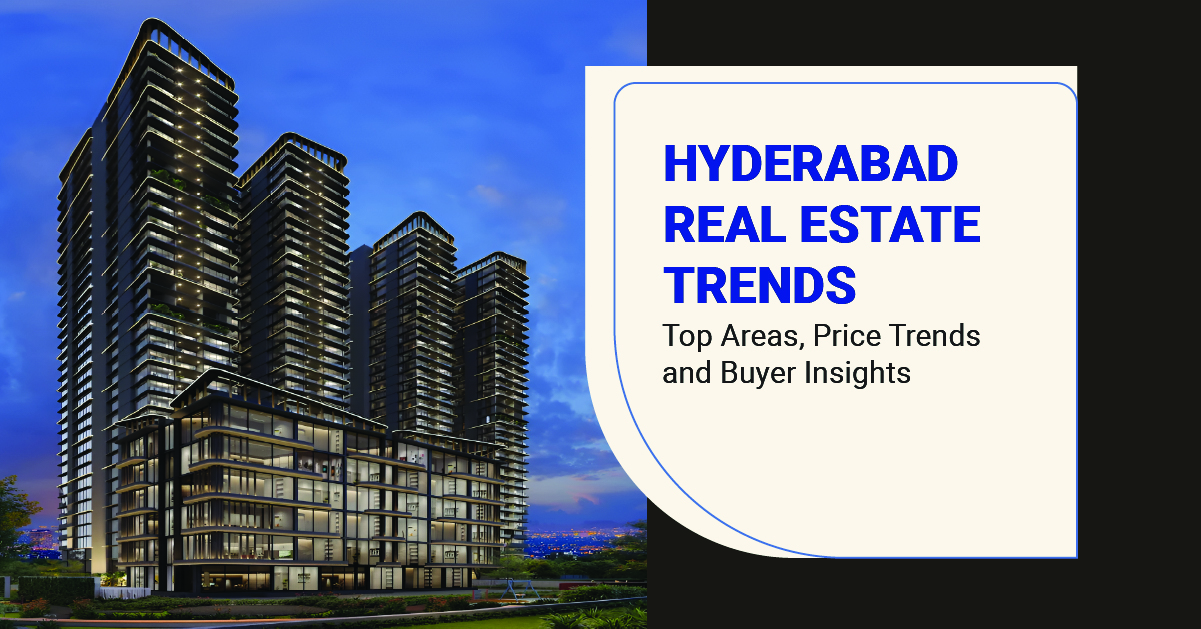
Hyderabad’s property market has grown from being just an affordable alternative to Bengaluru. Here, office leasing hit a record high in 2026, driven largely by Global Capability Centres. Every new campus that opens adds homebuyers nearby.
That is why Hyderabad real estate has become one of India’s most closely watched property markets this year. Prices are not moving the same way everywhere, though. Some corridors are already connected and stable. Others are pricing in infrastructure that has not been built yet. Let’s see where prices stand, which corridor areas are worth watching, and top buyer insights to check before you choose one.
Table of Contents
- What's Driving Hyderabad's Real Estate Trends
- How Prices Are Moving Across Hyderabad
- Growth Corridors to Watch Across the City
- A Closer Look at Hyderabad's Buyer Insights
- Choose the Hyderabad Corridor That Fits Your Timeline
- FAQs
What's Driving Hyderabad's Real Estate Trends
Hyderabad’s residential demand tracks its office market closely, and 2026 has been strong for both. Office leasing crossed 7.5 million square feet in the first half of the year, up 29% from a year earlier. Global Capability Centers (GCCs) were once again the biggest driver. Every campus that opens in the west adds employees who need homes nearby.
That demand is also shifting upmarket. Homes priced between ₹1 crore and ₹2 crore made up the largest share of Hyderabad’s sales in early 2026. For a buyer, this simply means fewer affordable options and tougher competition for what remains.
How Prices Are Moving Across Hyderabad
Hyderabad’s property pricing is closely tied to the city’s employment and development story. IT and GCC expansion remains a major demand driver, with areas close to established employment centres commanding stronger residential values. At the same time, improved infrastructure, access to established social amenities, and the development of larger integrated communities are supporting demand in newer residential markets.
Another clear shift is towards premium housing. This reflects stronger developer focus on higher-value homes and changing buyer preferences.
These factors help explain why an average Hyderabad real estate news headline does not tell the whole pricing story. A quick snapshot shows how values differ across key market segments. These differences become clearer when the major Hyderabad property markets are viewed side by side :
| Market | Typical Price Movement | What’s Behind It |
| Hyderabad (citywide average) | ~₹8,211 per sq ft, up ~9% year-on-year | Broad-based demand and a shift toward premium homes |
| West Hyderabad growth belt (Gachibowli, Kokapet) | ₹9,000–₹13,000 per sq ft | IT and GCC expansion, Financial District proximity |
Growth Corridors to Watch Across the City
Hyderabad’s growth is not happening in one direction. Three belts, shaped by different drivers, account for most of the current top areas, prices, and buyer preferences. These are:
- West Hyderabad: Gachibowli, Financial District, Kokapet and Narsingi
This part of Hyderabad remains closely linked to the city’s IT and GCC-driven housing demand. Gachibowli and the Financial District are major employment hubs, while Kokapet has developed into a premium residential market with large integrated communities.Narsingi benefits from its position between the Financial District and the airport side of the city, supporting demand for high-rise projects. Further out, Rajendra Nagar offers a different residential format. Casagrand Vybe, for instance, brings 5 BHK villas across 35 acres, with access to Gachibowli, HITEC City, Kondapur, and Kokapet. The contrast shows how housing choices are diversifying even within Hyderabad’s high-demand western market. - North Hyderabad: Kompally and Medchal
North Hyderabad has a different pricing profile from the city’s premium western markets, with Kompally offering a relatively lower entry point for homebuyers. Flats in the area average around ₹6,600 per square foot, with prices rising roughly 7% over the past year and close to 45% over five years. The area’s appeal is also supported by employment centres such as Kandlakoya IT Park and the Genome Valley life sciences cluster near Medchal, giving residential demand a local employment base.The housing mix reflects this range of buyers. Apartment projects such as Casagrand Evon cater to those looking for a mid-range format, while Casagrand Belair takes a lower-density approach with villas near the IT park. This gives buyers a choice between apartment living and larger-format homes without moving too far from the area’s employment and infrastructure network. - South Hyderabad: Attapur, Mamidipally and the ORR belt
South Hyderabad benefits from its position along the Outer Ring Road, giving residents access to the city’s southern exits and key routes beyond the city. That connectivity has supported residential development around established neighbourhoods such as Attapur and the ORR belt. These flats in Hyderabad average close to ₹6,500 per square foot. Prices in ORR have fallen roughly 1.5% over the past year, pointing to a sustainable demand in the area.The residential offering also spans different formats. Casagrand GS Infinity combines apartments with floor villas, while Casagrand Windsor Court near Mankhal is positioned close to ORR Exit 14. Together, these projects illustrate how ORR access supports both conventional apartment living and larger villa formats across South Hyderabad.
A Closer Look at Hyderabad's Buyer Insights
Price and corridor data only tell half the story. Who is actually buying, and why, shapes what happens to these numbers next. Hyderabad’s real estate trends show that:
- Premium Homes are Taking a Larger Share Of New Supply
Hyderabad has seen a sharp increase in high-end and luxury launches. In Q1 2025, these segments accounted for 83% of new launches, compared with 34% a year earlier. Rising construction costs, premiumisation and demand for larger homes were among the factors supporting this shift.
- New Supply is Growing Faster than Sales
Nearly 90% of Q2 2026 launches were in suburban locations. The west remained dominant, but Bachupally alone accounted for 20% of new launches, showing that buyers are not relying exclusively on the city’s established premium markets.
- The ₹1.5 Crore-Plus Segment Is Becoming Harder to Ignore
New Hyderabad launches priced above that mark made up close to 49% of supply in the second quarter of 2026, among the highest shares of any major Indian city. Buyers working within a Rs. 1.5cr budget will find fewer new-launch options and should expect to compare more resale or under-construction inventory.
- Rental Yield Is Keeping Pace With Capital Appreciation
ANAROCK data shows Hyderabad’s average residential price rising from ₹4,195 per sq ft in 2019 to ₹8,090 in Q2 2026, a 93% increase. Over the same period, average rental yield rose from 2.6% to 3.6%. The combination suggests that the city’s price growth has been accompanied by stronger rental economics rather than relying only on capital appreciation.
- Employment Growth Remains An Important Demand Anchor
Hyderabad’s office market recorded 9.1 million sq ft of net absorption in 2025, up 15% year-on-year. GCCs accounted for 34% of annual gross leasing, reinforcing the link between expanding employment centres and residential demand.
Choose the Hyderabad Corridor That Fits Your Timeline
Hyderabad’s real estate trends point in one clear direction: growth is real, but it is not evenly distributed. Some corridors are appreciating because their infrastructure already works every day, while others are appreciating because buyers expect it to work in the future. Neither approach is wrong, but they carry different levels of certainty, and it helps to know which one you are choosing.
If steady, already-connected living matters more to you than early-stage upside, established belts around Kompally, Attapur and the western IT core are worth a closer look. If you are comfortable waiting for infrastructure to catch up in exchange for stronger appreciation, the corridors along the proposed metro and Regional Ring Road routes deserve equal attention. Either way, builders such as Casagrand have ongoing projects in Hyderabad across each of these corridors, which is a practical place to start comparing your options against your own timeline.
FAQs
Which area is the future city in Hyderabad?
Kokapet is often considered one of Hyderabad’s major future growth areas because of its expanding infrastructure, commercial development, residential projects, and proximity to the Financial District and HITEC City. Other emerging areas include Neopolis, Narsingi, and the western growth corridor.
Is living in Hyderabad expensive?
Hyderabad’s living costs vary by locality, lifestyle, and housing choice. Areas such as Banjara Hills, Jubilee Hills, and the Financial District generally have higher housing costs, while several peripheral and developing areas offer comparatively lower living expenses.
Which part of Hyderabad is most developed?
Western Hyderabad is among the city’s most developed regions, particularly areas around HITEC City, Madhapur, Gachibowli, and the Financial District. These locations have extensive office spaces, residential communities, retail facilities, educational institutions, healthcare services, and established transport infrastructure.
Which business is booming in Hyderabad?
Information technology and related services remain major business sectors in Hyderabad, supported by its established technology clusters and growing Global Capability Centre presence. Pharmaceuticals, biotechnology, life sciences, financial services, and real estate are also significant contributors to the city’s economic activity.
What are big 4 companies in Hyderabad?
The Big Four accounting and professional services firms are Deloitte, PwC, EY, and KPMG. All four have significant operations in Hyderabad, serving areas such as audit, consulting, tax, risk management, technology, and business services.