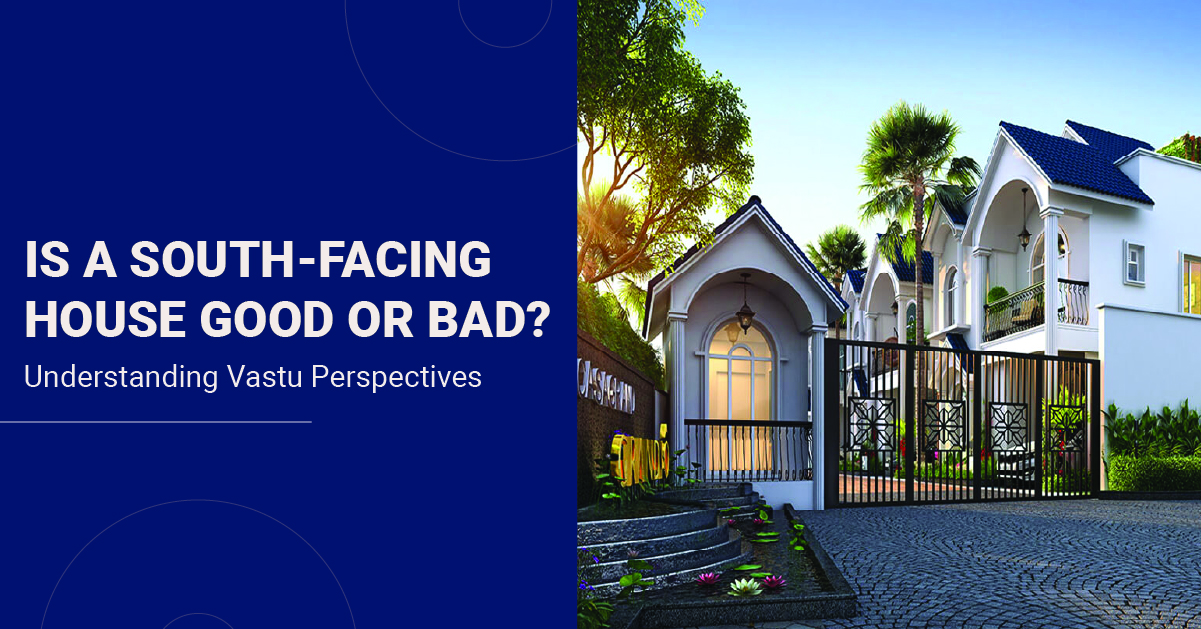
Questions around home orientation often create confusion among buyers, especially when it comes to traditional beliefs linked to Vastu. Among these, the idea of whether a south facing home is favourable continues to generate mixed opinions. Many homebuyers come across conflicting interpretations, which makes it difficult to understand what actually matters while selecting a property. As a result, decisions are often influenced by partial information rather than a complete understanding of Vastu principles.
The discussion around is south facing house good becomes more relevant when buyers realise that modern Vastu is not limited to direction alone. It takes into account layout design, ventilation, natural light, and overall spatial balance. In this blog, we explore the common myths around south facing homes and what actually matters from a Vastu perspective to help you make a more informed decision.
Table of Contents
- Myth vs Reality: Debunking Beliefs Around South Facing Houses
- Understanding Vastu as a Complete System and Moving Beyond Direction-Based Beliefs
- Rethinking South Facing Homes with a Balanced Vastu Perspective
Myth vs Reality: Debunking Beliefs Around South Facing Houses
If you are wondering if a south facing house is good or bad, and want some clarity over all the mixed beliefs around it. You need to know that these assumptions usually come from incomplete interpretations of Vastu, which focus only on direction instead of the complete design of a home. In reality, Vastu evaluates multiple factors together to determine balance and harmony within a space.
- Myth 1: South Facing Houses are Always Inauspicious
Vastu does not label south or south east facing houses good or bad. A house can be made into a home when the internal layout, room placement, and spatial balance follow Vastu principles. The overall design of the home matters more than its orientation. - Myth 2: North Facing Homes Are Always Better Than Others
While north facing homes are often preferred, Vastu does not rank directions in a strict hierarchy. Any orientation can work well when the home is planned correctly. A south facing home with proper design can offer the same level of comfort and harmony. - Myth 3: Direction Alone Determines the Energy of a Home
Energy flow in Vastu is influenced by multiple elements such as ventilation, sunlight, room positioning, and internal circulation. Direction is only one part of the framework. A balanced layout plays a much more important role in creating a positive living environment. - Myth 4: South Facing Homes Do Not Support Positive Living
Positive energy in a home depends on how spaces are structured and used. A south facing home with thoughtful planning can create a stable, comfortable, and well-balanced environment. Vastu focuses on harmony across all elements, not just directional bias.
Understanding Vastu as a Complete System and Moving Beyond Direction-Based Beliefs
Vastu should be viewed as a holistic design approach rather than a single-direction rule. When all elements such as layout, ventilation, natural light, and space planning are aligned, any home, including a south facing one, can support balanced and comfortable living. For buyers planning to buy a villa in Hyderabad, Chennai, or any other part of the country, understanding complete Vastu planning becomes more important than focusing on directional assumptions alone.
This broader understanding is important because modern homebuyers often make decisions based on isolated beliefs about direction, wondering if a south or south east facing house is good for them, which can limit their choices unnecessarily, especially when evaluating properties across fast-growing residential markets in South India. In reality, a well-planned home design has a far greater impact on comfort, energy flow, and day-to-day living experience than facing direction alone.
Moving forward with a complete Vastu perspective allows buyers to:
- Evaluate homes more practically based on design quality and functionality
- Avoid misconceptions that may eliminate otherwise well-planned properties
- Focus on long-term livability instead of directional assumptions
- Make more confident decisions based on overall spatial balance and comfort
Rethinking South Facing Homes with a Balanced Vastu Perspective
South facing homes continue to be misunderstood due to long-standing assumptions, even though Vastu principles are far more balanced and comprehensive than common beliefs suggest. Direction alone does not define the quality or comfort of a home, and many well-designed residences follow strong planning principles regardless of orientation. When aspects like layout, ventilation, natural light, and spatial organisation are thoughtfully executed, south facing homes can offer a highly comfortable and practical living experience.
For homebuyers, it becomes important to move beyond myths and evaluate homes based on their complete design rather than selective beliefs. A south facing home, when planned well, can support a stable and harmonious lifestyle while offering excellent long-term livability. Making informed choices helps buyers stay open to well-structured homes that may otherwise be overlooked due to misconceptions.