Commercial property investment in India continues to grow, with institutional investments reaching record levels in 2026 and office space absorption hitting new highs across major cities. Yet most buyers focus solely on the base price, unaware of the hidden tax layers that can add lakhs to their final payment.
What Determines If You Pay GST on commercial property or qualify for an exemption? Why do two buyers purchasing similar properties in different states end up with vastly different total costs?
This guide reveals the complete breakdown of GST implications for commercial property purchases, from construction status to state-specific levies.
Table of Contents
- Breaking Down Commercial Property GST Rates
- Additional Costs Beyond GST
- Smart Buying Tips for Commercial Properties
- Smart Commercial Property Buying Starts Here
- FAQs
Breaking Down Commercial Property GST Rates
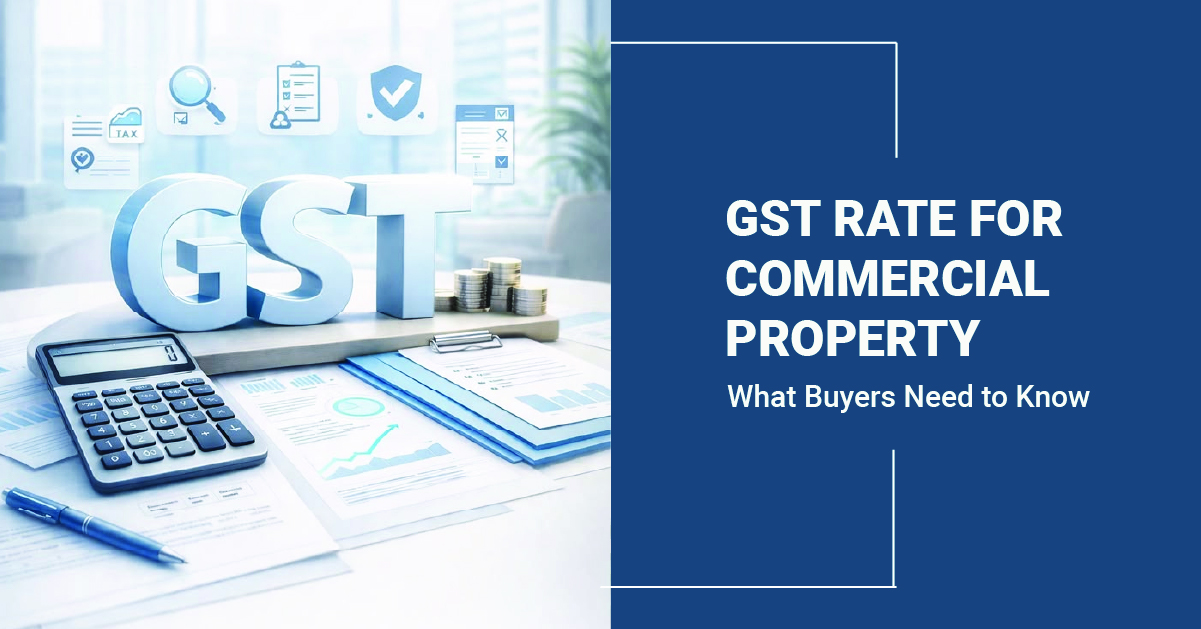
The GST rate for commercial property follows three distinct scenarios, each with its own rate and implications for your budget.
- 12% GST on Under-Construction Purchases
When buying commercial property, GST applies at an effective rate of 12% on the agreement value after deducting the land component. The taxable value is typically calculated as two-thirds of the total agreement value, with the remaining one-third attributed to land (which is GST-exempt).
Registered businesses can claim this GST on commercial property as Input Tax Credit against their output tax liability, reducing the effective tax burden. This makes under-construction properties particularly attractive for GST-registered buyers who intend to use the space for business purposes.
- 18% GST on Commercial Rentals
Commercial property rentals attract a GST rate of 18% on the gross rental amount, unchanged even after the GST Council updates effective from September 2025. This rate applies to all non-residential properties, including office spaces, retail shops, warehouses, godowns, and co-working spaces.
Landlords whose annual rental income exceeds ₹20 lakh (₹10 lakh in special category states) must register under GST and charge this rate on rental invoices. For inter-state rentals, the entire 18% is charged as IGST, while intra-state rentals split it as 9% CGST and 9% SGST.
- 0% GST on Ready-to-Move Properties
Ready-to-move commercial properties with a Completion Certificate or Occupancy Certificate are completely exempt from the commercial property GST rate. This exemption applies because the property is classified as a finished immovable asset rather than a construction service.
For those also exploring residential investments, they can opt for 2 or 3 BHK flats for sale in Hyderabad, Bangalore, or any other city, which offer similar GST exemptions. Making them an attractive choice for end-users seeking immediate possession without additional tax burdens.
Additional Costs Beyond GST
While GST on commercial property rates remain uniform across India, state-level levies can significantly impact your total transaction cost.
| State/City | Stamp Duty | Registration Fee | Transfer Duty | Total Approx. Cost | Notes |
| Maharashtra (Mumbai) | 6% (male), 5% (female) | 1% (capped at ₹30,000) | Not applicable | 6-7% | Registration cap benefits high-value transactions |
| Karnataka (Bengaluru) | 5% (above ₹45 lakh) | 2% | Not applicable | 7% | Revised registration fee effective 2026 |
| Tamil Nadu (Chennai) | 7% | 4% | Not applicable | 11% | Highest registration fee nationally |
| Telangana (Hyderabad) | 4% | 0.5% | 1.5% (urban/GHMC areas) | 6% | Transfer duty applies in urban areas |
| Delhi | 6% (male), 4% (female) | 1% | 1% (MCD, above ₹25 lakh) | 7-8% | MCD transfer duty on most properties |
| Kerala | 8% | 2% | Not applicable | 10% | Among the highest stamp duty rates |
| Haryana | 6% | 1% (capped at ₹15,000) | Not applicable | 7% (with cap benefit) | Registration cap provides savings |
When evaluating commercial property GST rates and total transaction costs, consider all applicable levies. For instance, a ₹1 crore property in Chennai costs approximately ₹11 lakh in stamp duty and registration, while the same property in Hyderabad costs around ₹6 lakh including transfer duty.
Smart Buying Tips for Commercial Properties
Beyond understanding the commercial property GST rate, strategic timing and accurate cost calculation can optimise your commercial property investment.
- Negotiate with sellers on under-construction properties by highlighting the GST burden you’ll bear compared to ready-to-move alternatives
- Check if the property falls under GHMC or urban limits before finalising, as transfer duty applicability varies by zone
- Verify the seller’s GST registration status to ensure you can claim Input Tax Credit on eligible transactions
- Consider female buyer benefits in states like Maharashtra and Delhi where stamp duty rates are 1-2% lower
- Plan your purchase timeline around financial year-end when sellers may offer better pricing to close deals
Smart Commercial Property Buying Starts Here
Navigating GST on commercial properties is just the first step in your investment journey. With the right knowledge of tax rates, state levies, and timing strategies, you’re now equipped to evaluate commercial properties with confidence.
Whether you’re comparing commercial property GST rates across different cities or calculating total transaction costs for buying commercial property, GST planning, the key is to look beyond the base price and factor in all applicable charges.
Ready to make your move? Start by requesting detailed cost breakdowns from sellers, compare stamp duty rates across your target locations, and time your purchase strategically based on construction status and your business needs.
FAQs
What is the GST rate on commercial property?
It depends on the property’s status. Under-construction commercial properties attract 12%, rentals attract 18%, and ready-to-move properties are completely exempt. The 12% on under-construction purchases is actually 18% applied only to the construction portion of the price; since land is GST-exempt, the taxable value works out to roughly two-thirds of the agreement value.
Is commercial real estate subject to GST?
Only in two cases: under-construction purchases and commercial rentals. Once a property has a Completion or Occupancy Certificate, it’s treated as a finished immovable asset and carries no GST.
Can I claim Input Tax Credit (ITC) on commercial property?
Yes, if you’re a GST-registered business buying an under-construction property for business use, you can claim ITC on the 12% GST paid. To protect your claim, verify the seller’s GST registration before paying and make sure the invoice carries your GSTIN. Missing documentation is the most common reason ITC claims get rejected.
What additional costs apply besides GST?
State-level levies can add significantly to your budget. Stamp duty ranges from 4-8%, registration fees from 0.5-4%, and states like Telangana and Delhi charge an additional transfer duty. One useful saving: female buyers pay 1–2% less stamp duty in Maharashtra and Delhi, so it’s worth structuring ownership accordingly.
What happens if I rent out a commercial property?
Rental income from commercial property attracts 18% GST, but only if your annual rental income crosses ₹20 lakh (₹10 lakh in special category states). Below that threshold, GST registration isn’t required at all. For inter-state tenants, the full 18% is charged as IGST; for intra-state rentals, it splits into 9% CGST and 9% SGST.