Introduction
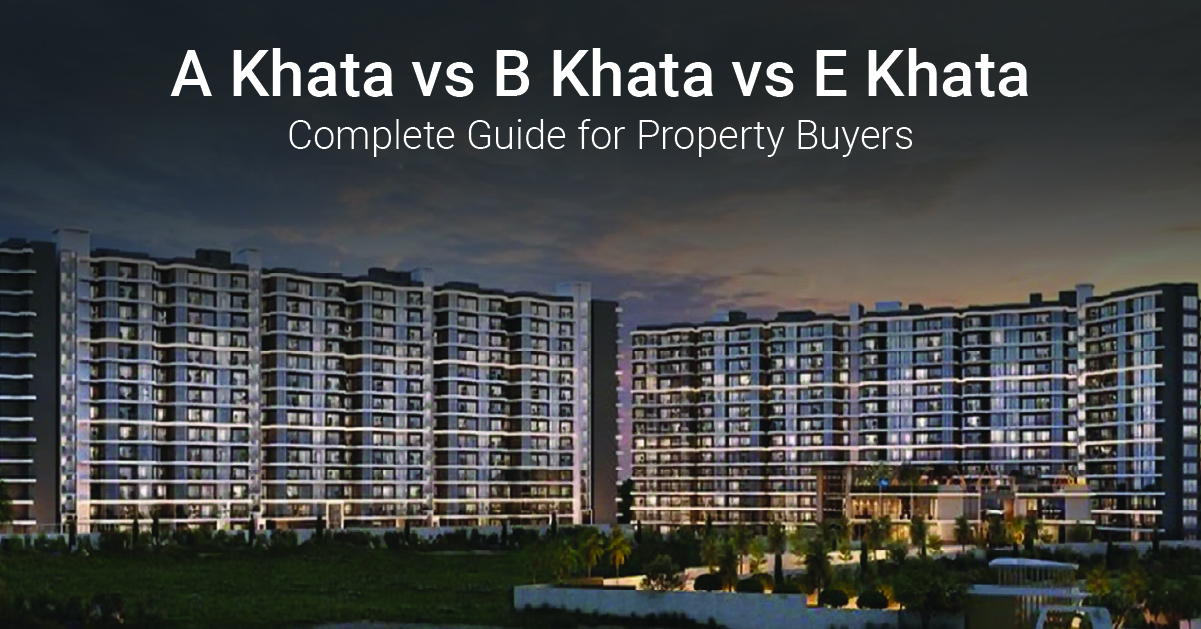
The real estate landscape in Karnataka, particularly in Bangalore, has undergone a seismic shift. For decades, property transactions were a maze of manual ledgers, physical certificates, and the perpetual confusion between “A Khata” and “B Khata.”
As of 2026, the Karnataka government has achieved a landmark milestone in digital governance by making the e-Khata (via the e-Aasthi portal) the absolute cornerstone of property ownership.
For a content strategist, investor, or homebuyer, understanding these documents is a technical necessity, especially when questions like “Is e-khata khata mandatory for registration?” are becoming central to every property decision.
This blog explains the legal rights of a khata and b khata in detail, highlights the shift to digital records, and walks you through a clear step-by-step process.
Table of Contents
- The Khata System: An Overview
- How to Apply for an e-Khata in 2026
- Common Pitfalls to Avoid
- Move Forward with Clarity in Your Property Journey
The Khata System: An Overview
A Khata is essentially a legal document that identifies a property within the records of a local municipal body, such as the Bruhat Bengaluru Mahanagara Palike (BBMP). It is a vital instrument for assessing and paying property taxes.
- A Khata: The Gold Standard of Compliance
An A Khata certificate is issued to properties that are fully compliant with all local building bylaws, land-use regulations (DC Conversion), and taxation norms. It signifies that the property is “legal” in every sense of the word.
The benefits of A Khata:
- Financial Leverage: Nationalised and private banks only provide home loans or Loans Against Property (LAP) for A Khata holdings.
- Approvals: It is a prerequisite for obtaining building plan sanctions and Occupancy Certificates (OCs).
- Market Premium: Properties with an A Khata command a higher resale value than their B Khata counterparts because they offer a “clean” exit for sellers and a “safe” entry for buyers.
- B Khata: The Secondary Register & Irregularities
The B Khata is not a separate document but an entry in a secondary register. It was created as a temporary measure to allow the BBMP to collect taxes from properties that had “irregularities.” These irregularities might include:
- Construction on land not converted for residential use.
- Significant deviations from the approved building plan.
- Lack of an OC.
While you can pay property tax with a B Khata, you cannot legally get a building plan approved or secure a loan from major financial institutions. In 2026, the Karnataka government introduced specific windows for regularisation.
Property owners can now transition from B to A Khata by paying “betterment charges,” provided the underlying land-use violations are rectifiable under current zoning laws.
- The e-Khata: Mandatory Digital Governance
In 2026, the question is no longer just “A or B?” but “Is it digital?” which is why understanding “what an e-khata in Karnataka is” has become essential for every property buyer.
The e-Khata is the digitised version of your property record. It is part of the city’s e-Aasthi system, which integrates property ownership, tax history, and location data into one verified online record.
The integration of the Kaveri 2.0 registration system with the e-Aasthi portal means that the sub-registrar’s office will no longer register a Sale Deed unless a verified e-Khata is present. This step was introduced to prevent fraud, especially when a single property is illegally sold to multiple buyers using fake documents.
This shift is not limited to Karnataka alone. Even in other fast-growing real estate markets, whether someone is evaluating options like a 4 bhk apartment for sale in Hyderabad or a villa in Pune, the focus is increasingly on clean digital records before finalising any investment.
How to Apply for an e-Khata in 2026
The BBMP has streamlined the application process, but it requires meticulous documentation. Whether you are handling an e-Khata transfer or digitising your existing property record, follow this roadmap:
1. Eligibility Check
- The property must be within the BBMP jurisdiction.
- You must be the legal owner with a registered Sale Deed.
- All property tax dues must be cleared up to the current date.
2. The Documentation Checklist
Here are the documents required for e-Khata:
- Sale Deed / Title Deed: The primary proof of ownership.
- Encumbrance Certificate (EC): A record of all transactions for the last 15–30 years.
- Latest Tax Receipts: Proof of payment.
- Approved Building Plan / OC: For constructed properties.
- GPS Coordinates: A photo of the property with a GPS timestamp (now a mandatory requirement).
- BESCOM Connection Number: This links your utility data to your Property ID (PID).
3. The Application Process (e-Aasthi Portal)
- Access bbmpeaasthi.karnataka.gov.in and log in via your mobile number and OTP.
- Search for your property using the PID (Property Identification Number).
- Review the “Draft e-Khata.” If the details match your deed, proceed to upload the documents mentioned above.
- The critical choice (Verified vs Unverified)
- Verified e-Khata: Select “Yes.” This triggers a manual review by the Assistant Revenue Officer (ARO). It takes 2–3 days, but is required for selling or registering the property.
- Unverified e-Khata: Select “No.” This is generated instantly. While it’s good for personal record-keeping, it will show as “non-transactable” on the registration portal.
4. Tracking and Downloading Your e-Khata
If you are wondering how to check e-Khata details online in Karnataka, the process is simple and fully digital through the e-Aasthi portal. You can track your status online:
- Application with CW: The Circle Writer is reviewing the digital documents.
- Application with ARO: The Assistant Revenue Officer is conducting the final check.
- Signed by ARO: Your e-Khata is approved and digitally signed.
- Ready for Registration: The document is now “pushed” to the Kaveri 2.0 system, allowing you to book a slot at the Sub-Registrar’s office.
Once the status is “Signed,” click the download link. The PDF is typically password-protected, and the password is usually your registered mobile number or application ID.
Common Pitfalls to Avoid
While applying for e-Khata, even small errors can delay or reject the process, so it is important to watch out for these common mistakes.
- Mismatched Dimensions: Ensure the dimensions in your Sale Deed match the e-Aasthi draft exactly. If there is a discrepancy, you must file for a “rectification” before the e-Khata can be verified.
- Missing EC: An e-Khata application without a recent Encumbrance Certificate (EC) will be rejected by the ARO.
- GPS Errors: Ensure the photo uploaded shows the actual property. BBMP uses these coordinates to prevent “double-mapping” of properties.
Move Forward with Clarity in Your Property Journey
Understanding A Khata, B Khata, and e-Khata has become essential for anyone involved in Bangalore’s property market. With BBMP moving towards full digital governance through the e-Aasthi system, property records are now more transparent, verified, and closely linked with registration processes.
While A Khata continues to represent full legal compliance and B Khata reflects irregularities that may be regularised, e-Khata has emerged as the mandatory digital layer. For buyers and owners, ensuring a verified e-Khata is now a key step for smooth transactions, secure ownership, and hassle-free property registration in Karnataka.