Ongoing
Projects
Projects
Ready to
Occupy
Occupy
Completed
Projects
Projects
Pre-Launch Projects
Future Projects








Buying a home is one of the most significant financial milestones in a person’s life. However, the cost of a property extends beyond its actual market price. To gain legal ownership of your property, you must account for additional statutory expenses.
This complete guide breaks down everything you need to know about stamp duty and registration charges so you can plan your home-buying budget seamlessly.
Stamp duty charges refer to a type of indirect tax levied by state governments and the Union Government of India on the sale of immovable assets, including land and buildings. This legal tax is also applicable to rental agreements, lease deeds, power of attorney, and loan documents.
Paying the stamp duty on house purchases serves as formal proof that the transaction has taken place. The tax rate typically varies between 2% and 7% of the property’s total value, depending on local state regulations.
Paying stamp duty is legally required under the Indian Stamp Act of 1899 and respective state-level stamp acts. It is mandatory because it ensures the legal validity of your transaction. If a property document is not properly stamped, it cannot be admitted as valid evidence in a court of law in case of a future legal dispute.
Furthermore, it serves as a critical source of tax revenue for state governments to fund public infrastructure.
The exact amount you owe is not a fixed flat rate for everyone. Several parameters influence the final calculation:
While stamp duty acts as the transaction tax, property registration charges are the administrative fees paid to the government to officially record the transfer of ownership in the municipal records. The local Sub-Registrar handles this registration process.
Unlike stamp duty, home registration charges across most Indian states are generally fixed at a standard rate of around 1% of the property’s market or agreement value.
Without registering your property documents, the entire transaction remains legally incomplete. Property registration ensures:
While both represent additional transaction costs, they serve entirely distinct legal purposes.
| Feature | Stamp Duty Charges | Property Registration Charges |
|---|---|---|
| Basic Nature | An indirect tax levied on transactional documents | An administrative processing fee for legal archiving |
| Purpose | Authenticates the legal validity of the agreement in court | Records the actual transfer of ownership to government books |
| Governing Authority | State Government & Indian Stamp Act, 1899 | Local Sub-Registrar’s Office of the specific jurisdiction |
| Typical Rates | Ranges widely between 2% to 7% | Usually capped around 1% of the property value |
To complete your apartment registration charges settlement at the Sub-Registrar’s office, you must present a verified set of documents:
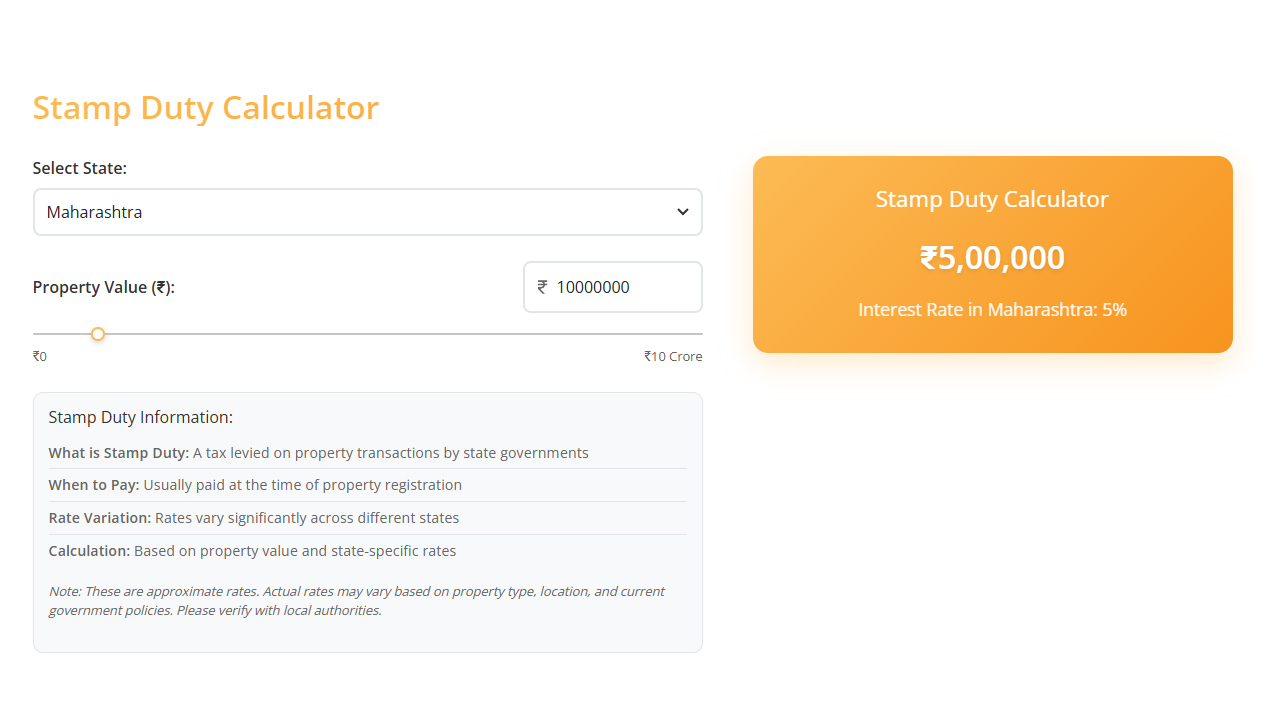
To calculate stamp duty and registration fees accurately, you must first verify the higher value between your property’s agreement price and the state-defined circle rate.
Formula:
The process of paying these dues can be completed via both online and offline avenues using three distinct structural methods:
As land and registration fall heavily within state jurisdictions, stamp duty percentages fluctuate significantly depending on where your property is situated. Below is an updated overview of the stamp duty rates and registration charges across major Indian states for 2026:
| States | Base Stamp Duty Rates | Registration Charges |
|---|---|---|
| Tamil Nadu | 7% | 4% |
| Haryana | Urban: 7% (Male) / 5% (Female) | Up to ₹50,000 |
| Punjab | 7% (Male) / 5% (Female) / 6% (Joint M+F) | 1% |
| Uttar Pradesh | 7% (Male) / 6% (Female) / 6.5% (Joint M+F) | 1% |
| Madhya Pradesh | 7.50% | 3% |
| Maharashtra | 6% (Male) / 5% (Female) / 6% (Joint M+F) | 1% (Up to ₹30 lakh) / ₹30,000 max (Above ₹30 lakh) |
| Assam | 6% (Male) / 5% (Female) | 8.5% |
| Rajasthan | 6% (Male) / 5% (Female) / 6% (Joint M+F) | 1% |
| Himachal Pradesh | 6% (Male) / 4% (Female) / 5% (Joint M+F) | Tiered: 4% to 8% based on value and gender |
| Bihar | 6% (Other cases) / 5.7% (M to F) / 6.3% (F to M) | 2% |
| West Bengal | 4% (Up to ₹25 lakh in municipal areas) / 5% (Above ₹25 lakh) | Varies by tier |
| Uttarakhand | 5% (Male) / 3.75% (Female) / 4.37% (Joint M+F) | 2% |
| Andhra Pradesh | 5% | 0.5% |
| Telangana | 5% | 0.50% |
| Chhattisgarh | 5% | 4% |
| Gujarat | 4.90% | 1% (No charges for female buyers) |
| Jharkhand | 4% | 3% |
| Kerala | 8% | 2% |
| Karnataka | 5% (Above ₹45 lakh) / 3% (₹21-45 lakh) / 2% (Under ₹20 lakh) | 1% |
Note: Many states offer special concessionary discounts of 1% to 2% on stamp duty charges if the primary property deed is registered in the name of a woman or a first-time homebuyer.
No, these statutory charges must be paid in full upfront before or during property registration. While the government does not allow instalment options, buyers often manage this upfront cost using personal loans or home loan top-ups.
Yes. Stamp duty is a transaction tax levied on the transfer of property ownership, not its construction status. Every time a resale property changes hands, the buyer must pay stamp duty based on the current market or circle rate.
Yes, executing an improperly stamped document attracts heavy penalties. Unpaid or short-paid stamp duty incurs a penalty, typically calculated at 2% per month on the deficit amount, which can accumulate up to a maximum of 200%.
Yes, multiple Indian states offer a 1% to 2% concession on stamp duty for properties registered solely or jointly in a woman’s name. However, specific restrictions, like minimum holding periods, vary across different state jurisdictions.
Common blunders include entering incorrect property dimensions, misspelling names, miscalculating circle rates, and ignoring structural details. Failing to account for applicable Tax Deducted at Source (TDS) or missing structural details can also halt the entire registration process.
Yes, most states permit a partial refund (usually deducting 1% to 10% for administrative costs) if the transaction is legally annulled. This requires a registered cancellation deed and a claim filed with the Collector of Stamps within statutory deadlines.


Chennai
99629 44444
Coimbatore
72993 70000
Bangalore
98848 00062
Delhi
97900 13840
Hyderabad
73581 35136
Pune
82200 34547
Dubai
44205777
NRI
91763 44444